Tim’s Take: Cameron has been exploring Melbourne’s wellness scene for us since early 2026, and one thing is becoming clear: the city punches well above its weight when it comes to thoughtful, design-led recovery experiences. From intimate head spas to float therapy and modern bathhouses, Melbourne offers remarkable variety for a city without a natural hot spring culture.
It’s fair to say that many cities around the world have similar spa scenes. A conveniently-located supply of hot springs that can be used as a font for different venues, the right balance of traditional and modern facilities designed to draw in new and regular customers, and other factors too.
What makes Melbourne’s spa scene unique is the overall context in which it operates.
A recent global survey found a lot of Melburnian respondents agreed with the statements that ‘My city makes me happy’ and ‘I find joy in the everyday experiences where I live’. This would be in no small part caused by the sheer number of spas that are available around Melbourne.
This guide of some of Melbourne’s top spas is for locals and tourists alike, whether they are just starting to get their feet wet with a spa experience, or if someone is a seasoned bather.
The criteria that were used to select inclusions were: range of experience (the three listed below are among the best examples in their specific service category); price range, and timeframe (from around an hour to close to two hours).
I visited all the listed spas below. This guide will keep growing as I find the next one worth writing about.
Best spas in Melbourne, Australia
Here is a quick overview of the three spas reviewed in this guide, with pricing and the experience each does best.
Spa
Location
Price range
Best for
Wellness Beauty & Head Spa
Melbourne CBD
Massage A$199–A$658 Head spa + massage A$399–A$1,174
A head spa and facial is for anyone looking for a little bit of luxury in areas that too often can be neglected in the humdrum of daily life. The website provides useful suggestions for people who are bald to consider the centre’s mini head spa treatment.
I went at the end of my working day, and I am pleased to report that the head spa and facial refreshed me for the night ahead. I would attribute part of this to the delicious catering that was provided – a cup of dried rose, red dates, longan, and goji berries tea that welcomed me, along with more tea and a platter of fresh fruit after my treatment.
It’s easy to feel like I was the only customer, not just in a literal sense but also in the sense that there was time to get to know Teresa and Lilly and learn about their professional backgrounds, and vice-versa.
I would definitely like to come back to Wellness Beauty and Head Spa. If the premium quality of my experience is any indication, the range of other treatments that are on offer are well worth the investment.
While vibes at the address are perhaps inconsistent with the grunge of surrounding industrial buildings and a hardware store, once you see the front garden beckoning you in, you begin to transition to the mood required to make the most of a one-hour float session, which is what I experienced.
Everything about Beyond Rest’s facilities speaks to the high level of care that has been invested. The room with the float pod includes a shower to rinse before and after your session.
On Beyond Rest’s website and in other marketing collateral, it’s emphasised that people will need more than one session to gain the full benefits of float therapy.
While that could be dismissed as a way to drive repeat bookings, I could see the merit after my session, which ended with the same gentle music to transition out.
Once I showered and dried, I followed a path to a lounge area with complementary tea and reading material. Alas, the outside world beckoned me too quickly, but as I collected my shoes from the entrance, I thought how remarkably simple the entire experience was.
It was on the last Tuesday of January 2026 that I visited Sense of Self (SOS), a boujee bathhouse built inside one of a number of converted brick warehouses in Collingwood and Fitzroy, in the inner northern suburbs of Melbourne, Australia.
After my session, I felt relaxed and rejuvenated. Perhaps one potential downfall of the self-directed model is that beginners like me may feel a little dazed and confused – there is plenty of great introductory material on the website, but once the heat is on, I felt like I was making it up as I went along.
One way of possibly solving this would be to offer an additional guide or chaperone service for those who felt they wanted to get the most out of their time.
Frequently Asked Questions
What types of spas are available in Melbourne?
More than most cities of its size. Melbourne has float therapy centres, hammam bathhouses, head spas, remedial massage studios, somatic movement spaces, hotel day spas, and hot springs within day-trip distance. The range is genuinely broad, which is part of what makes it worth writing about seriously.
How much does a spa experience in Melbourne cost?
Depends entirely on what you’re after. A single float session at Beyond Rest runs $89. A head spa and facial at Wellness Beauty and Head Spa starts at $199. A full hammam session at Sense of Self is $69 for bathing alone, with massage packages going up to $300. Budget a minimum of an hour of your time, and more if the experience warrants it.
Do I need to book in advance?
For most venues, yes. Melbourne’s better spas fill up quickly, particularly on weekends. Online booking is standard across the venues covered here. Same-day availability exists on weekdays but shouldn’t be relied on.
Are Melbourne spas suitable for first-timers?
Most are. Float therapy and hammam experiences have a steeper learning curve than a standard massage or facial, but the venues reviewed here provide good introductory material. Sense of Self is the one where a first-timer might feel slightly underprepared once they’re in the space. Worth reading the FAQ on their website before you go.
What is the difference between a day spa and a bathhouse in Melbourne?
A day spa typically offers treatment-based experiences delivered by a therapist, including facials, massages, head spa treatments, and so on. A bathhouse is self-directed: you move through pools, saunas, steam rooms, and cold plunge areas at your own pace. Sense of Self is Melbourne’s best-known bathhouse. Both formats appear in this guide because they serve different recovery needs.
Are there spas in Melbourne suitable for solo visitors?
All of them. Solo visits are common and unremarkable at every venue in this guide. The intimate format of Wellness Beauty and Head Spa arguably works better solo than with company.
What is the best spa in Melbourne for a special occasion?
Wellness Beauty and Head Spa is the answer here. The pricing reflects it, with treatments starting at A$199 and reaching A$1,174 for combined packages, but so does the experience. Therapists Teresa and Lilly treat every client as if they are the only one on the books that day. For a birthday, an anniversary, or simply a visit that deserves to feel genuinely memorable.
Tim’s Take: Five hours by car from Mildura. That’s how far some of Teresa’s regulars are traveling for a $299 head spa above a Chinatown restaurant strip. I’ve reviewed properties across twelve countries. The ones that earn that kind of loyalty don’t advertise it. Their clients do it for them.
On Monday, 30 March, 2026, I visited Wellness Beauty and Head Spa on Little Bourke St in Melbourne’s Central Business District for what was scheduled to be a 90-minute head spa and facial.
This ended up taking closer to two hours, which was only a good thing. The hospitality and generosity that therapists Teresa and Lilly extended to me will be something I always remember.
A head spa and facial is for anyone looking for a little bit of luxury in areas that too often can be neglected in the humdrum of daily life. The website provides useful suggestions for people who are bald to consider the centre’s mini head spa treatment. Unfortunately, the centre does not treat people with hair extensions, weaves, or wefts ‘to protect the integrity of extensions’.
Further Reading
The Wider Melbourne Picture
Wellness Beauty and Head Spa sets a high bar for five-star indulgence in the CBD. For a broader look at what Melbourne’s wellness scene offers across formats and budgets, the full guide is the place to start.
Clients who are pregnant should let the centre know in advance about any sensitivities or conditions so that the centre can prepare tailored treatment.
I went at the end of my working day, and I am pleased to report that the head spa and facial refreshed me for the night ahead. I would attribute part of this to the delicious catering that was provided – a cup of dried rose, red dates, longan, and goji berries tea that welcomed me, along with more tea and a platter of fresh fruit after my treatment.
When you arrive, you are invited to take off your shoes and socks and slip on some sandals, and you can also wear a robe to avoid getting your top wet during the treatment.
This treatment really is can’t-miss: in Teresa’s words, ‘it involves a beautiful mini facial, soothing massage encompassing the entire face, neck, shoulder, and scalp area, and the highlight of it all, the stunning water therapy ring with sensory tools.’
A blow-dry by Teresa finished the session. She makes the point that ‘some head spas end the treatment on the bed and the customer will dry their own hair in the toilet room.’
Facilities throughout Wellness Beauty and Head Spa, from reception to the treatment room, were pristine. Both Teresa and Lilly were really good at communicating what they were doing, and their expertise shined through.
Lilly served as a judge in the 2019 Miss World Australia Victoria finals after working in fashion and design for 20 years, while Teresa has studied courses in osteopathy and beauty and is passionate about the health and beauty industry.
Given I had my treatment at the end of the day, there was no crowding to speak of, although you should not mistake this for a lack of interest.
Teresa told me that since opening in July last year, people are coming from as far as Mildura (five hours by car or eight hours by train) to be treated by her and her team. According to Teresa, notable guests at the spa have included Yuliia Starodubtseva, a Ukrainian tennis player, Tom Gay, an actor and model, and TV news reporters.
People can book on multiple channels, but the online booking platform would appear to be the easiest.
According to a frequently asked question on Wellness Beauty and Head Spa’s website, there is no need to wash your hair before getting a head spa; however, there is probably a psychological element at play in posing this question, similar to why people tidy up before a cleaner arrives to do the same thing.
The head spa and facial I received costs $299. That seems a little pricey at first blush, but the quality of service that was provided easily matches or potentially exceeds that figure. From the moment you step out of the lift that takes you to Wellness Beauty and Head Spa, you are transported away from the din of Chinatown and into a place of serenity.
It’s easy to feel like I was the only customer, not just in a literal sense but also in the sense that there was time to get to know Teresa and Lilly and learn about their professional backgrounds, and vice-versa.
I would definitely like to come back to Wellness Beauty and Head Spa. If the premium quality of my experience is any indication, the range of other treatments that are on offer are well worth the investment.
I’m 36, train six days a week, and I have no idea how old my body actually is.
I document every session, blood panels, findings, and protocol changes, in my longevity journey.
This is a live document. I will add every session with Dr. Sarassawadee Suwanjinda (Dr. Petch) at Healthi Life Bangkok here, including the tests, the findings, her recommendations, and what changed.
Disclaimer: This article documents my personal longevity program and is intended for informational purposes only. It does not constitute medical advice. Consult a qualified physician before making changes to your health protocol. I am the Founding Ambassador for Healthi Life and receive a commission on bookings made with the TIM1000 code.
About this article
Written by Tim Kroeger, Founding Ambassador at Healthi Life Bangkok, based on his documented participation in the Elite Tier Individual Longevity Program beginning May 2026. Medical content reviewed and contributed by Dr. Sarassawadee Suwanjinda (Dr. Petch), MD, IBLM Diplomate, Co-Founder and Chief Medical Strategy Officer at Healthi Life Bangkok.
Healthi Life Review
Bangkok has become Asia’s most developed destination for longevity tourism, physician-led programs, advanced biomarker testing, and regenerative medicine at a fraction of Western prices.
I’m the official Founding Ambassador for Healthi Life Bangkok and started their Elite tier longevity program in May 2026.
This is my honest Healthi Life Bangkok review of a physician-led longevity treatment in Bangkok, documented over 90 days, including the biomarker results, what changed, and what didn’t.
After each session with Dr. Petch, I will add a section covering what was tested, the results, any changes made to the protocol, and my doctor’s recommendations.
The goal is not to create another longevity success story. It’s to document what actually happens when a physician-led, biomarker-driven protocol is applied over time.
Session 1: My First Day at Healthi Life Bangkok
May 12, 2026
I walked into Healthi Life assuming I already knew the answer. I train six days a week, sleep well, and eat carefully. By any visible measure, I look healthy. What I didn’t know was whether my body agreed.
Session 1 was entirely diagnostic. No results yet. The goal was to build the complete picture: body composition, blood markers, biological age, gut microbiome, cancer screening, and heavy metals. The kind of snapshot a regular annual checkup never takes.
✓Epigenetic age test (PPSpan — 11-organ biological age)
✓Cancer screening panel
✓Heavy metals panel
✓IV therapy — full body detox (1 hour)
InBody scan results — May 12, 2026
183cm · 36 years · Male · InBody score: 81/100
Weight
72.2 kg
Target: 73.7 kg
Skeletal Muscle Mass
37.2 kg
✓ Within normal range
Body Fat Mass
7.1 kg
✓ Within normal range
Body Fat %
9.9%
BMI 21.6
Visceral Fat
Level 2
✓ Low (scale: 1–10)
Basal Metabolic Rate
1,776 kcal
Rec. intake: 2,690 kcal
The body composition numbers were reassuring. Low visceral fat, muscle mass well within normal range, body fat at 9.9%.
The scan also showed a slight drop from the previous measurement in March 2026: weight down from 73.3 to 72.2 kg, skeletal muscle down marginally from 38.4 to 37.2 kg. Nothing alarming, but worth monitoring.
What Dr. Petch explained
The signs people often dismiss as getting older — feeling less energized, slower recovery, mental clarity that takes longer — those aren’t always aging. Sometimes they’re biological imbalances we can detect and correct early. That’s why this program exists: not to treat disease, but to make sure you never get there.
Dr. Sarassawadee Suwanjinda (Dr. Petch), MD — Healthi Life Bangkok
Dr. Petch walked me through the Elite Tier program structure. The program is built around four medical pillars: diagnostics and biomarkers, nutrition and metabolic optimization, hormonal balance, and gut microbiome and inflammation.
One thing Dr. Petch said reframed how I think about the whole system. Wearables give you lifestyle data. Regular doctors look for disease markers. Nobody connects the two.
Healthi Life sits in that gap, combining lab results, biomarkers, and wearable data into a single picture and translates it into specific, actionable guidance. Your sleep data and your blood panel are interpreted together, not in isolation.
The part that got my attention was the epigenetic age test. Not biological age as a single number, but a breakdown of 11 individual organ ages: heart, brain, kidneys, liver, lungs, and more. The test also measures the pace of aging, not just where you are now.
Dr. Petch’s own pace dropped from aging 14 months per calendar year to 8 months after she began her own protocol. The goal is to age more slowly than time passes.
Dr. Petch shared one case that stayed with me. A 30-year-old patient came in with a biological age of 48. She wasn’t in poor health by any conventional measure. She was tired, slower to recover, mentally foggier than she used to be. The kind of symptoms most people write off as normal aging.
After one year on a personalized longevity program, her biological age was tested at 30. An 18-year reversal. Dr. Petch mentioned the largest single-year improvement she has documented is 20 years. These are not estimates or projections. They are EpiSpan test results, measured before and after.
By the numbers
14 → 8
months of biological aging per calendar year — Dr. Petch’s own result
11
individual organ ages measured by the PPSpan test
4
Medical Pillars of Longevity tracked across the 3-month program
Based on the full diagnostic picture, Dr. Petch will design a 90-day protocol, covering gut microbiome, biomarkers, hormonal balance, and IV therapy. Here’s what the structure looks like in practice.
The 90-day plan structure
IV Therapy
Personalized infusions based on biomarker results. Session 1 started with a full body detox protocol targeting inflammation and mitochondrial function.
Supplements
Tailored stack to be confirmed after lab results and based on actual panel findings.
Nutrition
Specific foods to prioritize and avoid, personalized to my results. Not one-size-fits-all guidance.
Exercise Type
Guidance on which training modalities suit my specific markers. What to lean into, what to pull back on.
Monthly Check-ins
Progress reviews with Dr. Petch, wearable data integrated via the Healthi Life app. She can see my data between sessions in real time.
Program I’m doing
Elite Tier — Individual Longevity Program
3-month physician-led protocol · Pillars 1–4 · 12 IV drips · 5 consultations with Dr. Petch
Foundation
฿50,000
Pillars 1–2 · 4 IV drips · 2 consults
Advanced
฿80,000
Pillars 1–3 · 8 IV drips · 3 consults
My tier
Elite
฿115,000
Pillars 1–4 · 12 IV drips · 5 consults
Ultimate
฿150,000
All 6 pillars · 16 IV drips · 6 consults
Reader discount
Use code TIM1000 for ฿1,000 off your first treatment. Mention it when you book.
The IV drip took an hour, and I got a foot massage while it ran. That part I did not expect. The full-body detox formulation is designed to reduce inflammation, clear heavy-metal load, and support mitochondrial function. The lab results weren’t back yet, so there was nothing to react to yet. That comes in Session 2.
The gut microbiome test I completed at home. The clinic arranged a Grab driver to collect the sample once I was done. Which is either very Bangkok or very 2026, depending on how you look at it.
What stood out was the framing Dr. Petch uses throughout. This is not a hospital. You’re not here because something is wrong. You’re here because you don’t want to wait until something is wrong to find out. That logic made sense to me before I walked in. It made more sense after.
Watch: Session 1 — Full consultation and IV therapy
Session 2 — The results
May 27, 2026
The second session of my longevity program in Bangkok started with the lab results from Session 1.
Dr. Petch pulled up my dashboard and split it into two simple categories. What was working. And what wasn’t.
The left side was mostly green. The right side gave us our roadmap for the next 90 days.
What the panel found
The good news first.
Blood sugar regulation: excellent. Inflammation markers: outstanding. Heavy metals: clean. Cancer screening: normal. Hormones: already optimized, testosterone strong, no intervention needed. Phase angle 7.5, against a male benchmark of 6. HDL cholesterol at 55-67, well above the 40-50 benchmark.
Then the other side.
LDL cholesterol is elevated and imbalanced relative to HDL. Not at the medication level, Dr. Petch’s recommendation was three to six months of lifestyle modification first, given my discipline. She’s confident it will come down without pharmaceutical intervention.
Homocysteine, a marker for vascular inflammation, is at the upper end of normal. Not alarming, but worth addressing. Linked to the LDL finding.
Lymphocytes at 1,000, against a benchmark of 1,500. Not a disease. A sign that the immune system is running slightly under-resourced. Likely connected to sleep quality.
Muscle mass trending down across all three InBody scans. This one surprised me. I train six days a week. Dr. Petch’s explanation was direct: I’m not eating enough to support the training I’m doing. At 9.9% body fat, when the body needs energy and doesn’t have enough fuel, it breaks down muscle instead of fat. The training is working against itself.
Session 2 — Key findings
7.5
phase angle male benchmark is 6.0
55–67
HDL cholesterol benchmark is 40–50
1,000
lymphocytes benchmark is 1,500
4,315
D-Dimer µg/L normal range under 500
And then the D-Dimer.
The Finding: A Deep Dive into Biological Stress
My D-Dimer came back at 4,315 µg/L. To put that in perspective, the standard reference range is typically under 500 µg/L.
D-Dimer is a biomarker that tracks blood clotting activity and protein breakdown. In high-performance athletes, intense weight training or structural muscle damage the day before a blood draw can cause this marker to spike temporarily. However, because it is also used to screen for serious vascular issues like deep vein thrombosis (DVT), a number this high requires immediate medical context.
When I shared my family history of thrombosis, the clinical protocol shifted instantly from standard optimization to proactive screening. Dr. Petch immediately conducted an on-site physical evaluation, checking for localized vascular inflammation and swelling, to ensure there were no signs of an acute condition.
Once she verified that I was completely asymptomatic and that the numbers lined up with extreme training stress, she mapped out a highly proactive monitoring plan. Instead of waiting a full month for a standard follow-up, she scheduled a strict, rested re-test just two weeks later.
This marker tells us your body is managing a heavy amount of physiological and recovery stress. Because of your family history, we aren’t going to guess or leave it to chance. We will support your vascular system immediately, allow your body to recover, and re-test under controlled, rested conditions.
Dr. Sarassawadee Suwanjinda (Dr. Petch), MD
She also added Nattokinase to my protocol, a natural enzyme with emerging evidence for supporting healthy blood flow and vascular health.
The symptoms to watch for, per Dr. Petch: sudden swelling in one leg, difficulty breathing. If either appears, that’s a hospital conversation, not a clinic visit.
I left knowing what to look for.
The 90-day protocol
Based on the full panel, Dr. Petch built the personalized plan.
Nutrition changes:
Increase caloric intake to match training load
90 to 120g of protein per day
Complex carbohydrates before and after training. The body needs fuel to build muscle, not break it down
Oily fish (salmon, sardines) three to four times per week
Switch from coconut oil to olive oil; the coconut oil I’d recently added was likely contributing to LDL elevation
Eat before 7 pm to allow digestion before sleep
Training changes:
Two full rest days per week, or very light movement only
No intense training in the Bangkok heat
The goal: let the body recover enough to actually build the muscle it’s being asked to build
Sleep:
Sleep was identified as the foundational priority. Dr. Petch connected the lymphocyte count, the muscle recovery issue, and the immune function gap to suboptimal sleep. Fix the sleep, and several other markers follow.
I mentioned I’d already started going to bed at 10pm and getting morning sunlight on the balcony for 15 minutes before touching my phone. She called it an amazing job.
Supplements and IV:
The personalized IV for Session 2 included vitamin C for immune support, B12 (methylcobalamin, the active form) to reduce vascular inflammation, magnesium for muscle recovery and sleep, zinc for immunity, and glutathione. Fish oil supplement added for cholesterol management. No magnesium supplement added separately, my levels were within range, and she doesn’t believe in loading supplements without a clinical reason.
The follow-up blood test for the D-Dimer was scheduled for two weeks later. I left not knowing whether the number would come down or stay elevated.
It came down.
Program I’m doing
Elite Tier — Individual Longevity Program
3-month physician-led protocol · Pillars 1–4 · 12 IV drips · 5 consultations with Dr. Petch
Foundation
฿50,000
Pillars 1–2 · 4 IV drips · 2 consults
Advanced
฿80,000
Pillars 1–3 · 8 IV drips · 3 consults
My tier
Elite
฿115,000
Pillars 1–4 · 12 IV drips · 5 consults
Ultimate
฿150,000
All 6 pillars · 16 IV drips · 6 consults
Reader discount
Use code TIM1000 for ฿1,000 off your first treatment. Mention it when you book.
Session 3: First Signs That My Longevity Treatment in Bangkok is Working
June 10, 2026
The InBody score went from 78 to 81. Dr. Petch showed me the number before saying anything else. All the work is starting to pay off, and she directly connected it to lifestyle changes. Supplements and IV aside, the shift in how I live day-to-day is already showing up in the cellular health data.
The muscle mass chart is the clearest signal. Skeletal muscle peaked at 39.5kg in early April, then declined steadily to 36.9kg by late May. Two weeks of following Dr. Petch’s recommendations and it’s back up to 37.1kg. The trend reversed faster than I expected.
The D-Dimer recheck required stopping heavy training for two days prior. Dr. Petch is not alarmed by the marker but wants to monitor it closely.
The IV drip that followed ran for 90 minutes. The protocol included high-dose Vitamin C, Vitamin B complex, methylcobalamin (the absorbable form of B12), folic acid (B9), NAC, glutathione, and magnesium. Targets: vascular inflammation, oxidative stress, and cholesterol recycling.
A few protocol updates from today. If weight training and cardio happen in the same session, weights come first. Creatine stays at five grams per day. The whey protein I am currently using contains sucralose, which interferes with gut microbiome composition and signals the brain to crave more sugar. Finish the current tub, then switch to a clean alternative. On eggs: pulled back from four or five per day to three whole eggs, with any extras as egg whites only.
Healthi-Life provided me with a Whoop to track sleep, HRV, and recovery. All data syncs directly into their platform, where Dr. Petch can monitor and interpret the trends. I can also photograph meals to calculate nutrition, log drinks, and add notes on how I feel day to day.
The D-Dimer Result Came Back
June 11, 2026
The next day, the repeat D-Dimer test came back at 285 µg/L, which is within the normal range. Dr. Petch’s message:
Your repeat D-Dimer result is excellent news. It has dropped from 4,315 µg/L to 285 µg/L in less than four weeks and is now well within the normal range. This is very reassuring and suggests the previous elevation was most likely related to training stress, recovery demands, and overall physiological stress rather than any serious underlying issue. This means we can confidently continue with your longevity programme and focus on optimizing recovery, sleep, energy, and performance moving forward.
Dr. Sarassawadee Suwanjinda (Dr. Petch), MD
The First Dream I Can Remember in Years
June 12, 2026
Healthi Life gave me a Whoop during Session 3. I’ve tracked training metrics for years, but I’ve never looked at my sleep this closely.
The second night I wore it, my REM sleep came in at 30%, above the typical 20–25% benchmark. Sleep stress sat at 0% for 97% of the night.
The numbers were interesting. What mattered more was what happened when I woke up.
I remembered a dream.
That might not sound like much, but I honestly can’t remember the last time I woke up with a dream still in my head. It had been years.
Seeing the Whoop data afterwards made the experience make more sense. REM sleep is where dreaming happens, but it’s also where a lot of the brain’s cognitive and neural restoration takes place. For the first time, I could connect how I felt with something measurable.
Dr. Petch wasn’t surprised at all.
Your nervous system can only expand its time in deep, restorative REM states when it feels biologically safe. When we systematically lower systemic inflammation, clear vascular stress, and align your circadian eating window, your body drops out of a sympathetic ‘fight-or-flight’ state. Waking up with vivid dreams is a beautiful subjective sign that your nervous system is downshifting and your cellular recovery is actually working.
Dr. Sarassawadee Suwanjinda (Dr. Petch), MD
She explained that improvements in sleep architecture naturally follow as systemic inflammation comes down and the autonomic nervous system becomes less activated. My D-Dimer had already normalized; my sleep architecture was simply following the exact same trend.
It’s far too early to draw conclusions from a single night. But as first signs go, waking up and remembering a dream felt like a pretty good one.
Coming next: Session 4 on June 24, 2026
Frequently Asked Questions
Reader discount
Use code TIM1000 for ฿1,000 off your first treatment. Mention it when you book.
What is the Individual Longevity Program at Healthi Life Bangkok?
The Individual Longevity Program at Healthi Life is a 3-month physician-led protocol designed by Dr. Sarassawadee Suwanjinda (Dr. Petch). It is structured around six medical pillars: diagnostics and biomarkers, nutrition and metabolic optimization, hormonal balance, gut microbiome and inflammation, sleep and recovery, and performance and biological age. The program is available in four tiers, ranging from ฿50,000 to ฿150,000, each activating progressively more pillars. It is not a wellness package; it is a clinical protocol built from your individual biomarker data.
How much does the Elite Tier longevity program cost at Healthi Life?
The Elite Tier costs ฿115,000 for a 3-month program. It covers Pillars 1 to 4, includes 12 IV drip therapies and 5 consultations with Dr. Petch. Pricing across all tiers ranges from ฿50,000 (Foundation) to ฿150,000 (Ultimate). Final investment is confirmed after a complimentary discovery consultation.
What tests are included in the first session of the longevity program?
Session 1 is entirely diagnostic. It includes an InBody 270S body composition scan, a full blood panel covering hematology, inflammation, and vascular markers, urine analysis, an epigenetic age test measuring 11 individual organ ages (EpiSpan), a cancer screening panel, and a heavy metals panel. A gut microbiome stool test is completed at home after the appointment. The first session also includes an introductory IV drip therapy, in my case, a full-body detox protocol targeting inflammation and mitochondrial function.
How much does a longevity program cost in Bangkok?
Longevity programs in Bangkok are significantly more affordable than equivalent physician-led protocols in the US or Europe, where comparable programs typically cost between $8,000 and $20,000 USD. At Healthi Life Bangkok, the Individual Longevity Program is available in four tiers: Foundation at ฿50,000 (approximately $1,400 USD or €1,300), Advanced at ฿80,000 (approximately $2,200 USD or €2,050), Elite at ฿115,000 (approximately $3,200 USD or €3,000), and Ultimate at ฿150,000 (approximately $4,200 USD or €3,900). All tiers run for three months and include physician consultations and IV drip therapies. Final pricing is confirmed after a complimentary discovery consultation with Dr. Petch.
What is epigenetic age testing, and what does it measure?
Epigenetic age testing measures how old your body is functioning at a biological level, independent of your chronological age. The Epispan test used at Healthi Life goes further than a single biological age number. It breaks down the biological age of 11 individual organs, including the heart, brain, kidneys, and liver. It also measures your pace of aging: how many months you biologically age per calendar year. This allows the medical team to identify which organs are aging faster than expected and target interventions accordingly.
How is a longevity program different from a regular health check-up in Bangkok?
A standard health check-up is designed to detect existing diseases. A longevity program at Healthi Life is designed to identify optimization gaps and biological imbalances before they become disease. The program combines 80 to 120 biomarkers across six medical pillars, integrates wearable data with lab results, and produces a personalized 3-month intervention protocol covering IV therapy, nutrition, supplementation, and exercise guidance. It is physician-supervised throughout, with monthly check-ins and real-time monitoring between sessions.
Can international visitors do the Individual Longevity Program at Healthi Life Bangkok?
Yes. Healthi Life has treated guests from more than 50 nationalities and offers multilingual support in English, Thai, Chinese, Arabic, and French. International visitors can begin with a complimentary discovery consultation, either in person or remotely, to determine the right program tier. Medical concierge services are available for fly-in guests on the Ultimate tier.
What happened when the Session 1 lab results came back?
My Session 1 lab results were reviewed during Session 2 on May 27, 2026. One marker came back above the safe limit, with no prior symptoms and no warning signs. It was caught only because the full panel was run. Dr. Petch presented the findings and built a personalized 90-day intervention plan based on the complete diagnostic picture. Full results and the protocol are documented in Session 2.
How long does a longevity program in Bangkok take to show results?
A longevity program in Bangkok can show early biomarker results within two to four weeks. In my experience at Healthi Life, my D-Dimer dropped from 4,315 to 285 µg/L in less than four weeks, and my InBody score improved from 78 to 81 within three sessions. For biological age reversal, Dr. Petch’s patients typically see measurable EpiSpan results after six to twelve months of consistent protocol adherence. The short answer: some biomarkers respond within weeks; biological age reversal requires sustained commitment over months.
Is a longevity program in Bangkok worth it?
For me, yes, but not for the reasons I expected. This Healthi Life Bangkok review documents exactly what I found. I walked in thinking I was healthy. A full blood panel caught a D-Dimer marker at 8x above normal with zero symptoms. That finding alone justified the cost of the program. Bangkok offers physician-led longevity programs at 60-80% less than equivalent programs in the US or Europe. The Elite Tier at Healthi Life is ฿115,000, roughly $3,200 USD for a 3-month physician-supervised protocol with 12 IV sessions and 5 consultations. Whether that’s worth it depends on how seriously you take preventive health. If you’re waiting until something is wrong to find out, it probably isn’t for you. If you want to know what’s happening inside your body before it becomes a problem, it’s hard to argue against.
Tim’s Take: A vacation changes your location, not your decision load. Terry names something the wellness industry rarely admits, that beautiful is not the same as restorative, and the difference is what your nervous system actually feels on day four.
It wasn’t always dramatic or obvious. It usually crept in slowly, quietly, and steadily over time, and the signs were usually subtle.
Maybe a low, humming, consistent state of fatigue. Maybe it was the dreadful questions on what to eat for dinner. Maybe it was every notification that popped up on my phone. Maybe each commute to work that came with a sidedish of crushing anxiety and the question: “Am I going to be late again today?”
Or maybe it’s the entire thing. My whole life. All of it. I was in full burnout mode between the ages of 30 and 40 years old. An entire decade.
Most of us find ourselves in this state at some point in life, especially as midlife approaches and the responsibilities are endless. From running businesses to taking care of families to aging parents to more responsibilities at home, bigger financial pressures, and everything in between. I was doing it all without realizing my nervous system was fried.
I desperately started seeking out anything that would help me. An escape from my life, work, and myself. And the options were endless. From simple vacations all the way to divorce and an entire career change. I was up for all of it.
So I did what I always did. I booked trips. One on top of the other. From Spain to Greece, to Napa Valley, to Montreal, to Mexico. I would go anywhere.
I was good at booking trips. I would scroll through hotels at 11 p.m. and feel hopeful for the first time all week. This is it, I’d think. I just need to get out of here.
Somehow, the magical solution was always on the other side of that flight.
To my disappointment, it never worked that way.
The first 3 days of “vacation,” I was like a crack addict going into withdrawals. I couldn’t stop checking my phone, emails, messages, responding to clients, and taking calls. It was a cortisol addict who panicked over having to relinquish control and just relax. It felt uncomfortable having “nothing to do.” So instead, I would cling to my old patterns.
By day 3, things would feel a bit more settled, but I was still surgically attached to my phone and the stress that came with it.
Or I’d be at breakfast, and my mind would already be three moves ahead. What time are we leaving? Should I book the excursion now or wait? Did I respond to that email? My phone would end up in my hand again without me noticing. I’d be sitting across from someone I love at dinner, and I wasn’t quite there. Present in body, a million browser tabs open in the head.
It took me an embarrassingly long time and many trips to figure out why. 5 years to be exact.
It Wasn’t the Destination. It Was Me And My Brain.
I wasn’t just physically tired. I was cognitively and emotionally shot. My nervous system fried. I was making, and I’d estimate I’m lowballing this: somewhere around two hundred decisions before lunch.
What to wear. What to eat. What to say yes to. What to push. Who to call first. Whether the thing my son or daughter was telling me required a response or a nod. Whether my husband’s tone was a tone or I was reading into it. Whether to schedule the doctor’s appointment, I’d been avoiding. What the team should prioritize this quarter. Whether that font was right.
Researchers have a name for this. They call it decision-making fatigue. And once you know about it, you see it everywhere. It’s why judges make harsher rulings before lunch. It’s why Obama famously wore the same two suits. He said he didn’t want to waste a single brain cell on his wardrobe. It’s why you stand in front of the fridge at 9 p.m. and cannot, for the life of you, decide what to eat, even though you’re hungry.
Here’s the part nobody told me: a vacation doesn’t turn decision fatigue off. If anything, it turns it up.
On vacation, I was still deciding. Constantly. Where should we eat? Is this restaurant worth the drive? Should we try the snorkeling tour or just lay by the pool? What do you feel like doing today, honey — because I’d really rather not be the one who picks, but here I am picking again.
Every beautiful choice was still a choice. My nervous system didn’t know the difference between “pick a restaurant in Tulum” and “pick a vendor for the Q4 launch.” It was all just my brain, still on, still running.
By the end of most trips, I’d come home feeling like I needed another vacation to recover from my vacation. – Terry Tateossian
By the end of most trips, I’d come home feeling like I needed another vacation to recover from my vacation. Which, I realize now, is a joke we all make. But it’s not actually funny. It’s a symptom.
The First Time I Felt an Actual Reset
The first time I experienced something genuinely different, it didn’t look like what I expected.
I’d signed up for a wellness retreat almost on a dare from a friend, the kind where somebody else decides when you eat, what you eat, when you stretch, and when you rest. I remember feeling annoyed in the first hour. I don’t like being told what to do. I like to be the one who plans things. That’s the whole problem, obviously, but I didn’t see it yet.
By day two, something weird happened. I woke up, and I didn’t check my phone. Not out of discipline. I just didn’t think of it. Somebody rang a quiet bell at 7 a.m. I ate what was in front of me. I went where they told me to go. I moved my body the way the teacher suggested. I didn’t pick a single thing, and it was the most rested I’d felt in maybe a decade.
That was the difference. That was the thing I’d been missing.
I wasn’t paying to be somewhere beautiful. I was paying not to be in charge for four days.
What I See in the Women I Work With
The older I get (I’m turning 50 this year), the more I notice the same thing in the women around me. Nobody comes to me saying I need a vacation. They say, I’m so tired I can’t even think.
They say, I want to rest, and then I can’t actually rest. They say, I don’t feel like myself anymore.
What they’re describing, almost always, is the same thing. They haven’t had a real break from being the person who holds everything together, probably in years. Sometimes decades. Sometimes, since their first kid was born.
A vacation changes your location. And that’s lovely. But if you come home still exhausted, it’s because your environment wasn’t the only problem.
Your brain was -is- still the manager on duty, even in paradise.
What I needed, and what I think a lot of women over forty need, is the chance to hand over the decision-making for a few days. – Terry Tateossian
What I needed, and what I think a lot of women over forty need, is the chance to hand over the decision-making for a few days.
To have someone else decide what’s for breakfast, lunch, and dinner. To have the schedule already made. To have the meals and the movement and the rest already built in, so my nervous system can finally exhale.
That’s what a real retreat is, when it’s done well. It’s not an escape. It’s not more work for you to do. It’s not deciding or controlling. It’s permission to breathe. Permission to be.
If You’ve Felt This Too
If you’ve tried all the trips. If you’ve sat on a beach you paid a lot of money to get to and still felt that constant hum in your mind. If you’ve come home from Italy somehow more tired than when you left. Maybe the rest you need is not physical. Maybe for once, you need a true mental break.
Give it that, even for a few days, and you’ll be amazed at what comes back.
Namia River Retreat is a 60-villa wellness sanctuary on the Thu Bon River, 2.5 kilometers outside Hoi An Old Town. In this review, I evaluate the property’s sleep environment, environmental calm, nutritional offering, included daily wellness journeys, movement infrastructure, and service through the Restorative Index, the framework I built for travelers who want to return home feeling better than when they arrived.
I chose Namia for my birthday.
That sentence would have made no sense to me ten years ago. When I started traveling, a birthday meant nightlife, noise, and being close to where the action was. Fifteen years and 112 countries later, I book my birthdays differently. Sleep quality. Spa programming. Quiet rooms. Real food. The kind of stay that resets the nervous system rather than depleting it further.
Namia delivered on every one of those criteria.
If you’d rather see it than read it, here’s the full video review.
The drive from Da Nang took roughly forty minutes. I stepped out of the car into the welcome lounge, and the temperature shift was immediate. Not the temperature of the air. The temperature of the environment. The honking, the heat, the density of central Hoi An. All of it was gone within thirty seconds of arrival.
I stayed two nights at Namia in 2026 to evaluate whether the property genuinely restores energy or simply photographs well. As my Restorative Index score of 9.5/10 suggests, this is the most complete wellness property I have evaluated to date. Not just a beautiful resort with spa facilities. A sanctuary with deliberate, structured recovery programming integrated into every dimension of the stay.
If you want to return from Hoi An feeling measurably better than when you arrived, Namia River Retreat belongs at the top of your shortlist.
At a Glance
9.5/10 Restorative Index
Property
Namia River Retreat
Location
Hoi An, Vietnam
Room Category
Nipa Pool Villa (Villa #222)
Last Stayed
May 2-4, 2026 (2 nights)
Price
~$962/night for two, including daily 90 minute spa treatment per person
Best For
Recovery-focused travelers, couples, solo wellness stays
Transparency: Fully hosted stay. Opinions are solely my own.
The bed had several pillows in different firmnesses, and I picked the one that worked for me. A small detail. The kind that signals a property paying attention to sleep without making a marketing event of it.
The mattress was genuinely well-chosen. Soft enough to sink into within minutes, firm enough to maintain spinal alignment, and crucially, it did not trap heat. In a humid tropical climate, mattress thermoregulation is the difference between waking up rested and waking up sweaty.
The air conditioning held the set temperature consistently through the night, which is non-trivial in a villa this size. There was no AC noise. No compressor cycling audible from the bed. The villa also offered two ceiling fans on remote control, which I used in combination with the AC to fine-tune airflow without overcooling the room.
The acoustic isolation inside the villa was effectively perfect. Across two nights, I heard nothing from neighboring villas. From inside the villa I could not hear the river boats either, even in the early evening when some of them passed playing music.
That sound only reached me when I was walking around the wider property, and even then it read as part of the riverside atmosphere rather than as competing noise. It never extended into sleeping hours. The only ambient sound from inside the bedroom was the occasional bird call at dawn.
The lighting design separates a good wellness property from a great one. Reading lights on either side of the bed used warm-toned bulbs that did not interfere with melatonin production when used at night.
More importantly, the path from the bed to the bathroom had a motion-activated indirect light at floor level. Warm color temperature. Just bright enough to see where I was going. Dim enough that I could fall back asleep within minutes of returning to bed.
Most luxury hotels overlook the middle-of-the-night light exposure problem entirely. Namia engineered around it.
There was no other light pollution inside the room. The radio alarm clock had a small LED display that was easy to turn off. The air conditioning unit had no visible indicator light. The bedroom was dark. As it should be.
The single point of improvement, and the reason this category scores 28 out of 30 rather than a perfect 30, is the curtains. They darken the room significantly, but morning light leaks in at the bottom edges and along the sides. The villa is not 100 percent blackout. For most guests this will be a non-issue and may even be welcome. For travelers managing jet lag or sensitive sleep architecture, it is a meaningful gap.
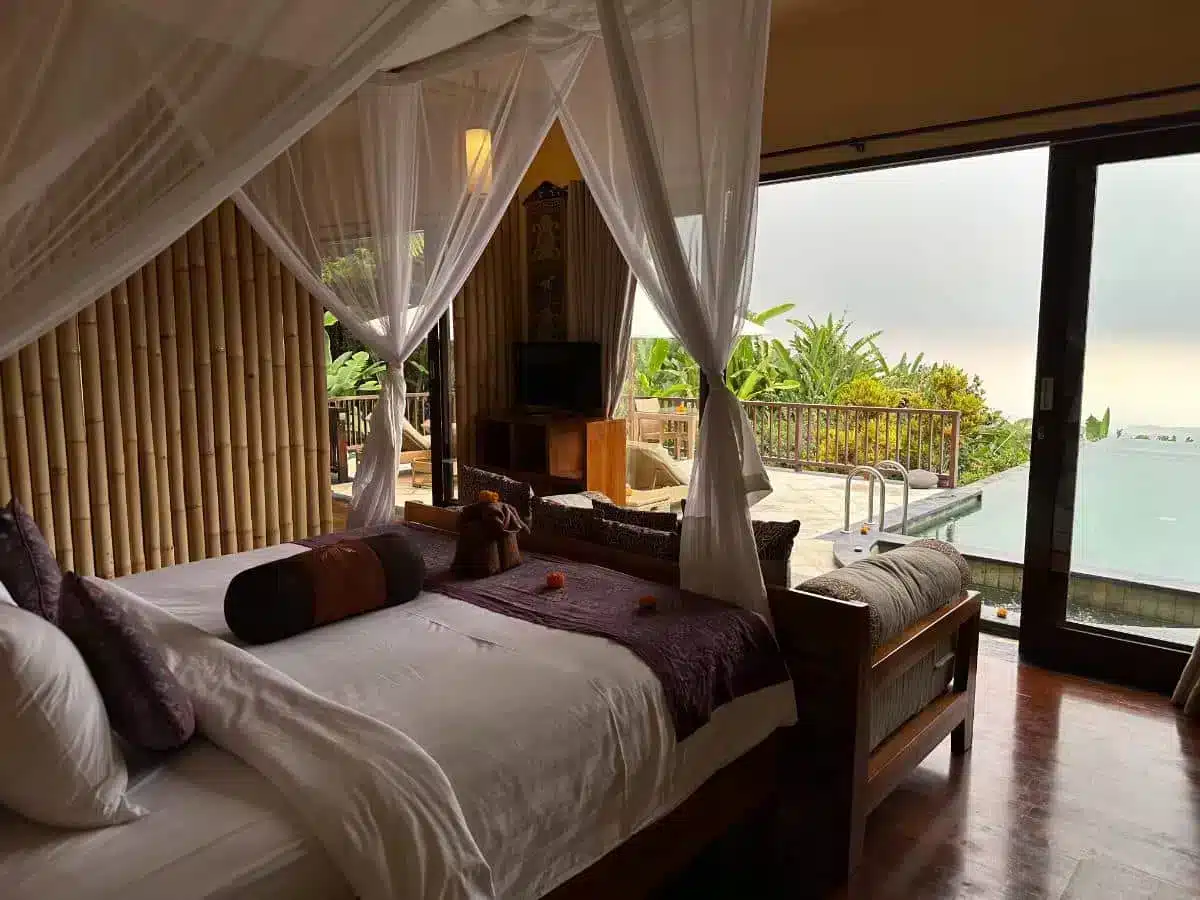
Once I did wake up, however, the morning light access was exceptional. I could open the curtains, walk straight outside, and find myself in front of my private pool with an uninterrupted view of nature.
I spent the first fifteen minutes of every morning at Namia outside, in natural light, before checking any screen. That window of unfiltered morning sunlight is one of the most powerful inputs available for circadian rhythm regulation. At Namia, it is built directly into the villa’s geometry.
I also developed a small ritual on day two. Wake up, open the curtains, step outside, jump into the private pool. The water temperature was held at a level that felt refreshing without being shocking. A genuinely useful nervous system cue to start the day connected to the environment rather than to a phone.
Namia engineered around middle-of-the-night light exposure. Most luxury hotels still don’t.
Environmental Calm & Nervous System Regulation — 20/20
The property’s geography is the foundation. The villas sit on what is effectively a small private island, accessible only by a single internal bridge.
No through traffic. No passing scooters. No commercial activity bordering the property. The sensory environment is sealed off from the chaos of central Vietnam in a way that very few wellness properties manage to achieve.
The villa privacy is excellent without being absolute. My villa was spaced roughly five to ten meters from its neighbors on either side, with planted trees and a screening fence between properties.
From inside the villa, the private pool, or the outdoor shower, I could not hear my neighbors at any point during the stay. I could occasionally see them in the distance, which prevented the privacy from being total, but the buffer was generous enough that this never felt intrusive.
Combined with the type of guest Namia attracts, who tend to be calm, quiet, and present, the privacy in practice was far better than the architectural specification alone would suggest.
The soundscape is the real environmental asset. Birds. The Thu Bon River. Wind through the planted trees. The occasional boat in the early evening, sometimes carrying music, which read as part of the experience rather than competing with it.
Across the broader resort, the same calm held. Even at peak times like breakfast, when the property’s 60 villas can theoretically generate meaningful guest density, the atmosphere remained relaxed.
The breakfast restaurant has both indoor and outdoor seating. Most guests sat inside due to the heat and humidity, but the space never felt crowded. The temperature was held well. The food presentation was unhurried.
The visual environment is equally deliberate. Namia is built around three concepts: crafted with nature, life by the river, and ritual of life. In practice this translates to bamboo, wood, stone, and water as the dominant materials, with nothing competing visually.
Seen from above, the property’s pathways branch from a central axis like a tree, with each villa positioned at the end of a branch. It is a design principle most guests will never consciously register. But it is doing real work. The geometry creates privacy without producing isolation.
The microclimate is not cooler than central Hoi An in the way Munduk Moding Plantation’s altitude is cooler than coastal Bali. Namia is at sea level, in the same humid environment as the rest of the region.
What it offers instead is a sealed environment within that climate. The air feels cleaner because it is not carrying scooter exhaust or street dust. The temperature feels manageable because the property’s tree canopy and water features moderate it locally.
From the moment I crossed the bridge until the moment I left, I felt disconnected from the chaos of travel. That is the entire point of environmental calm as a Restorative Index dimension, and Namia delivers it without compromise.
The bridge is the only way in. That detail does the work that most spa marketing budgets cannot.
Nutritional Impact & Stable Energy — 14/15
I evaluated breakfast across both mornings of my stay. I did not eat lunch or dinner on-property. The breakfast experience alone justified a near-perfect score, and the breadth of options was the most thoughtful I have encountered at a wellness property in Southeast Asia.
Protein availability was excellent. Eggs were prepared in every style on request: fried, scrambled, omelette, poached. Smoked salmon was on the buffet daily, alongside additional fresh fish options. Grilled chicken was available. Stir-fried vegetables. Sourdough bread. The protein-forward eater has every option needed to start the day strong.
The Vietnamese side of the breakfast offering is equally well-developed. Local dishes are available alongside the international options, which is important. You are in Vietnam. You should be able to eat Vietnamese food at breakfast if you want to. Namia treats this as a feature rather than an afterthought.
The juice program is a small detail that signals serious intent. Freshly squeezed watermelon juice. Orange juice. Other rotating fruit options. None with added sugar. The kind of consideration that most luxury hotels overlook, defaulting to bottled or pre-mixed juices that spike blood sugar without contributing meaningfully to nutrition. Namia got this right.
The coffee is high quality. The matcha is well-made. The tea selection is broad. For guests who use morning caffeine as part of their daily energy routine, the options are there, and they are executed competently.
For guests who want to indulge, the buffet also includes fresh croissants and other sweet options. This is a wellness property, not a clinic. The choice belongs to the guest. Namia provides the protein-forward, low-glycemic toolkit alongside the indulgence options without judgment in either direction.
The single point deducted reflects the absence of a structured nutritional wellness program. There is no in-house nutritionist on staff. There is no curated anti-inflammatory or wellness-aligned menu, no integration between the kitchen and the spa’s wellness offerings. For a property scoring this highly across every other dimension, even a simple curated wellness menu highlighting the highest-protein, highest-density options would close the gap to a perfect score.
Namia gives you the protein-forward toolkit and the croissants. No judgment in either direction.
Bioregulation & Spa Recovery — 15/15
This is where Namia separates itself from every other wellness property I have evaluated.
Every guest receives a 90-minute wellness journey, every night of their stay, included in the room rate. Read that again. Not a spa add-on or a marketing inclusion. The structural center of the Namia experience. Guests come to Namia for the spa programming as much as for the property itself.
Across two nights, I experienced two full journeys. The first paired a hammam with a Vietnamese traditional massage. The second paired a sauna and ice bath circuit with a massage.
The intake process tells you everything about the operational seriousness. On my first visit to the spa, I completed a detailed health questionnaire covering blood pressure, skin sensitivities, injuries, surgical history, and medical conditions.
The therapist asked about pressure preference, soft, medium, or firm. She walked me through every available treatment option, explaining each one in detail. For the hammam I was offered four different scrub options, each with different active herbs and different intended effects.
Staff suggested specific pairings based on what I told them I wanted from the session. This is the consultation depth I expect from a clinical wellness property, not from a hotel spa.
The hammam ritual was genuinely traditional, not aesthetic theatre. The therapist mixed the herbal scrub in front of me, explaining what each component did. Perilla. Mugwort. Jasmine. Angelica. Honey.
He had the actual plants on display so I could see them before they went into the mix. The scrub itself happened on a heated stone slab inside a steam room. The Vietnamese traditional moxa stick ritual followed, with the burning herb passed around the face for what they call the smoking ritual. It is a little hot. It is also genuinely therapeutic in a way most hotel spa rituals are not.
Between the hammam and the massage, the spa offers a small relaxation room with a window facing the river. Five minutes of tea and a ginger snack to let the nervous system register the transition between treatments. A small detail. Also the difference between a sequence of spa treatments and a coherent therapeutic protocol.
The massage rooms upstairs offer some of the best treatment-room views I have experienced. Floor-to-ceiling windows over the river. Soft lighting. Quiet music. No outside noise penetrated the room at any point. The therapist worked with skilled, consistent pressure and checked in periodically without breaking the silence.
The sauna and ice bath circuit on day two was the standout. The sauna is private, with a window facing directly onto the river.
The therapist guided me through the sauna sequence, applying different oils and aromatherapy elements throughout, explaining each step. We finished with a brief breath work session inside the sauna, which significantly deepened the parasympathetic response.
The ice bath sits outside the sauna, also with a river view. After an outdoor rinse shower, I went directly into the ice bath. If you stay at Namia, time the sauna and ice bath circuit for early evening. As the sun sets, the boats passing on the river light up. You sit in the cold water watching the river illuminate. One of the most distinctive recovery moments I have experienced anywhere.
The spa environment is exemplary. Quiet. Clean. Well-lit for downregulation rather than display. Privacy is structural, not performative. Staff anticipate transitions rather than reacting to them.
What pushes this category to a perfect 15/15 is the integration. Treatments are not standalone services to be selected from a menu. They are paired, sequenced, and recommended based on what each guest tells the team they need.
The thermal contrast is guided. The hammam includes a structured rest interval. The sequencing is built. Most luxury hotel spas offer the components.
Most luxury hotel spas offer the components. Namia offers the protocol.
Biomechanics & Movement — 8/10
Namia’s gym is small but exceptionally well-curated.
The equipment selection signals that someone with actual training experience designed it. A cable machine for full-body work. A combination machine for squats and bench press. Free weights in the 2.5 to 10 kilogram range. Two treadmills. A stepper. Two stationary bikes for cardio. The gym does not try to be a full commercial fitness center. It selects the most useful pieces of equipment for the typical wellness guest and executes that selection well.
The environment matters as much as the equipment. The gym sits inside the property with large windows looking out onto greenery, abundant natural light, and individually controllable air conditioning.
I was able to set the gym to roughly 18 degrees Celsius, which made training in a tropical climate genuinely comfortable. Across two days, I had the gym entirely to myself for every session. For guests who want serious training during a wellness stay, this is operationally excellent.
The yoga program is the second movement pillar, and it is strong. Four guided classes per day in a dedicated yoga studio next to the gym. The studio is quiet, well-temperature-controlled, and equipped properly.
The instructor was professional, attentive, and personalized her teaching to each attendee. Before every class she asked about medical conditions, prior yoga experience, and any movement restrictions.
She remembered names. She corrected form individually. The sleep yoga class at 8 PM was the highlight. I would book a return stay for that program alone.
Beyond the gym and the studio, Namia integrates movement into the broader stay. Two complimentary bamboo bicycles per villa, parked at the entrance, available for use on the property and into Hoi An Old Town with a provided lock.
A daily complimentary guided cycling tour to the Old Town for guests who want a structured option. Guided boat tours where the guest can take over the rowing if they want upper-body work. The main pool is large enough for serious lap swimming. Running and jogging around the property is possible and I saw a few guests doing it.
The two points deducted reflect the absence of structured group fitness programming inside the gym. A daily 30 to 45-minute circuit class, or a single fitness class held at the main pool, would meaningfully expand the movement category for guests who want more variety without leaving the property. Adding this would be a relatively low-cost intervention with disproportionate impact, and would close the gap to a perfect score.
Namia selects fewer machines and uses every one of them better than most resort gyms five times the size.
Frictionless Operations & Cognitive Ease — 10/10
This dimension measures something most luxury hotels overlook: the cumulative cognitive cost of being a guest. Every decision you have to make, every miscommunication you have to resolve, every moment you spend waiting or wondering drains the same finite energy pool that the property’s other wellness features are trying to replenish.
Namia eliminates friction with a discipline that earns the highest possible score in this category.
On check-in, every guest is assigned a personal host who handles every request for the duration of the stay. The host is reachable directly via WhatsApp at any hour, including when the guest is off-property.
I tested this. Whatever I needed, I sent a message. Whatever I sent, was handled. No front desk to call. No phone tree. No “please hold” while my request was transferred. One person, one channel, one accountable point of contact across the entire stay.
The in-villa phone provides a backup channel for any operational request: housekeeping, food and beverage, transport. Calling for a golf buggy from any point on the property reliably produced a buggy at my villa within five minutes. Not a single appointment ran late across two days. The sunset cruise, the spa appointments, the guided activities, all started exactly on time and required no follow-up from me.
What separates a 10 from an 8 in this category is anticipation rather than reaction. By the second day, the staff had identified my preferences and were providing them before I asked.
I never had to ask the same question twice. I rarely had to ask any question at all.
Across two nights, the stay felt effortless. Not a single moment of cognitive friction.
Luxury, properly understood, is the removal of unnecessary decisions. Namia understands this.
Restorative Index — Score Breakdown
9.5/10
Dimension
Weight
Score
Sleep Architecture
30
28
Environmental Calm
20
20
Nutritional Impact
15
14
Bioregulation (Spa)
15
15
Biomechanics (Movement)
10
8
Frictionless Operations
10
10
Restorative Index
100
95
The Prescription
The Ideal Guest: Namia River Retreat is built for the guest who wants to leave Vietnam having genuinely recovered, not just having traveled.
Burned-out professionals who need a hard reset. Couples seeking a honeymoon environment that values shared silence over shared entertainment. First-time wellness travelers who want a property where the program is built rather than self-assembled.
Solo travelers, of any gender, who understand that two nights of structured restoration can deliver more than a week of unstructured leisure. Guests who pay attention to sleep, recovery, and food, and who want a property that pays the same attention back.
The Wrong Fit: Not the property for guests who need external stimulation to feel that their vacation is working.
No nightlife on-property. No party scene. No curated entertainment program. No proximity to bars, late-night restaurants, or the action of central Hoi An beyond a complimentary daily shuttle. Guests who define a holiday by activity density rather than recovery quality will find the offering too quiet.
The Final Verdict — The ROI of Rest
Namia River Retreat is the most complete luxury wellness property I have evaluated. The score reflects that.
What separates it from every other property in this category is the integration of recovery into the structural design of the stay. The 90-minute wellness journey is not a bonus or an upsell. It is the spine of the experience.
Two nights at Namia delivered three hours of guided, professionally executed spa programming, layered on top of sleep architecture engineered with real attention to detail, environmental calm achieved through deliberate geographic and architectural choices, food that supports performance, movement options that make staying in shape effortless, and a service operation that eliminates the cognitive friction most luxury hotels quietly impose on their guests.
At approximately $962 per night for two people, with all activities, breakfast, and the daily 90-minute wellness treatments included, the price-to-restoration ratio is exceptional.
The included spa programming alone, valued individually, represents a meaningful portion of the rate. The remainder buys you a private pool villa on a sealed-off riverside property in one of Vietnam’s most distinctive locations. The math makes sense.
I chose Namia for my birthday because I wanted to spend the day on something that paid me back. Sleep that left me sharper than when I arrived. Spa programming that worked on my nervous system rather than just my muscles. Food that supported the morning workout rather than undermining it. A service team that anticipated what I needed before I had to ask.
You will leave Namia River Retreat feeling better than when you arrived. Measurably so. The only metric that matters.
Book Namia River Retreat
From ~$962/night for two, including daily 90-minute wellness journey.
Tim’s Take: Cameron’s take on Fresh Treatments lands where most first-timers land on vitamin boosters: the energy bump is real enough to notice but small enough to argue with. That’s consistent with what the science actually says about B12. If you’re genuinely deficient, a shot is useful. If your levels are fine, it’s a $50 placebo with a needle.
The more interesting signal in his review is the clinic itself. Fine needles, calm staff, a nurse who’s been there four years, a detailed intake form before you sit down. That’s the stuff that separates a legitimate wellness centre from a strip-mall drip bar, and it matters more than any single booster on the menu.
It goes without saying that a vitamin B12, or any similar, booster is for anyone who is OK with being jabbed with a needle; however, Fresh Treatments says it caters to people who are sensitive by taking ‘a gentle, supportive approach. Our team is experienced in working with nervous clients – we use fine needles, offer a calm environment, and take our time to ensure you feel comfortable throughout the process.’
Further Reading
More Melbourne Wellness Worth Your Time
A vitamin booster is a good starting point. Melbourne has a full spectrum of recovery experiences beyond the IV drip. Cameron’s guide covers the ones that have earned a genuine recommendation.
Fresh Treatments offers a range of boosters, and it says the B12 booster can contribute to people’s ‘overall wellness routine’. According to the centre, the types of people who ask for this booster include individuals with low energy or fatigue, athletes looking for recovery and performance support, vegans and vegetarians (who may lack dietary B12), busy professionals needing an energy boost and people with known B12 deficiencies or absorption concerns.
Vitamin boosters is just one of several services that Fresh Treatments offers. You can also partake in an IV infusion, cryotherapy, an infrared sauna session, oxygen therapy, normatec pants (designed to increase circulation), and a body analysis.
From a quick glance before and after my booster, the rooms at Fresh Treatments looked modern and clean. The booster room was fairly cosy, with just enough room for the nurse and me.
The process itself is fairly straightforward, and you can choose to have the booster injected into your glute, where it will be absorbed more quickly, or into your arm. The nurse will then apply a sticker to the point of injection.
I got my booster in the evening, after another day’s mental labour. For me (and, I suspect, many people), this is when I feel the most careworn, and my energy levels for the day and week have dropped most.
Merve, the nurse who administered the booster, told me that I was going to feel the effect most the following morning. What’s interesting is that once I returned home, I definitely wasn’t as tired as I would have been (possibly not because of the booster but perhaps because of my expectations about my newfound energy), but as the evening wore on (nothing exciting apart from a session at the gym), the usual fatigue claimed its place.
Given I was suffering from the remnants of a self-inflicted stomach ache, it’s possible the booster alleviated my symptoms after 12 hours or so.
Before getting a booster, Fresh Treatments will send you a detailed form that asks about your medical history. One reason for this is to ensure there aren’t any complications from the booster.
Fresh Treatments recommends you speak with a doctor first if you are managing chronic health conditions, taking certain medications, or are unsure about your B12 levels or symptoms.
The room where I received the booster appeared to double as an office and was a little cosy, perhaps, but more than enough room for the nurse and I. My squiz of other rooms before and after showed the usual level of cleanliness that you would expect at any modern wellness centre.
Fresh Treatments says it ‘adhere(s) to medical-grade hygiene standards, including single-use sterile needles, proper skin preparation, clinical waste disposal protocols, and clean, controlled treatment environments.’
Merve was effective in her delivery of the booster. Having worked at Fresh Treatments for four years, she said it was a nice environment to work in, which reflects back in other reviews on Fresh Treatments’ website. Janice Ford wrote, “The staff were friendly” and the “(n)urse was very efficient at giving me vitamin B12 injection”.
‘Most clients are pleasantly surprised by how quick and comfortable the process is, and often say they wish they had tried it sooner,’ Fresh Treatments says.
Another common theme in reviews from customers found on the website was the ease with which bookings can be made. This is thanks to an online booking system that matches with the range of services that are available.
The vitamin B12 booster I received costs $50. This is another one of those wellness services where the benefits are likely to accumulate over time after repeat treatments. Fresh Treatments says, ‘While many clients report increased energy and improved wellbeing, B12 is not a “magic fix”. Results vary depending on your baseline levels and overall health. It works best as part of a broader wellness approach.’
But this booster was still highly valuable in chasing away the remnants of some leftover lurgy.
Tim’s Take: Cameron’s pick is a different kind of recovery review, a 50-minute somatic class in a Carlton studio for $55, no hotel spa attached. The question I ask of any recovery experience is whether you walk out more regulated than you walked in, and sound-led somatic work has a real case to make on that count.
The detail that stood out in Cameron’s write-up is the headphones. Piping Alan Watts directly into your ears while your body is in a grounded yin hold is smart design. It sidesteps the HVAC noise, the echo, the person breathing hard next to you. One class won’t shift your sleep or HRV. But as a standalone recovery hour in Melbourne, it’s a genuinely different proposition.
On Tuesday, 7 April, I visited Soluna Society, a holistic healing centre that offers 50-minute sessions incorporating yoga, breathwork, meditation, Pilates, cardio and somatic work – and the best of modern technology through provided ‘disco’ headphones that participants wear that not only quietened outside noise, but also heightened my connection with the instructor.
Further Reading
One Studio. One City. Many Options.
Somatic movement is one layer of what Melbourne’s wellness scene does well. Cameron has reviewed the venues that do the rest just as thoughtfully, from float therapy to five-star head spas.
My session – Soluna Slow, one of five sessions on offer depending on your preference – combined ‘slow somatic movement and healing modalities’ to calm my body. The session is based around four natural elements: breathwork (air); grounding yin yoga and stretching (earth), fluid movements (water) and meditative practices (spirit).
In general terms, Soluna Society says it aims ‘to provide a class for every body’, and it tends to attract four types of people:
Emotionally-aware individuals looking to advance their self-knowledge and add new coping skills to their toolkit.
People with a passion for wellness, looking to connect with and belong to a like-minded community.
Curious, open-minded people wanting a new way to move their body and tap into their inner world.
Stressed out, time-poor, dysregulated people who are looking for a break from the hustle through a complete wellbeing solution.
(Readers can make their own judgments about which of these categories I fit into. I am happy to hedge my bets and say a little of columns A, B, C and D).
Immersive Audio: Philosophers in Your Ears
Sessions can be booked through an online platform, but it does seem like the business would prefer to correspond over email or social media first as a way to get to know people who are interested.
What is perhaps unique or at least a point of difference about Soluna Society is how it uses the headphones not just to provide a clearer and more accessible way of listening to the instructor that isn’t distorted by the outside world or even the echoes of the studio, but also to include soothing background music and grabs from philosophers.
My session included an extract from ‘The Love of Wisdom’, Alan Watts’ radio series, where he compares faith to clinging on a rock.
Again, the novel part of Soluna Society’s session (at least to me), was being able to reflect as a group (including Gracie, the instructor) at the end about it. As I shared, if my university philosophy classes had combined Watts’ words with something similar to Soluna Slow, I might have absorbed lessons a bit more!
The Space: A Cozy Corner in Carlton
The facilities where Soluna Society is based – a wellness centre off Lygon St in Carlton (Melbourne’s little Italy) – were excellent. On the top floor of the centre, where Soluna Society holds classes, there is a shared locker room for people to store their belongings safely.
I don’t think I saw toilets or a private place to change anywhere in the building, so I would recommend arriving in exercise gear. The studio itself is cosy and is perfect for small groups of people.
With that said, there could be a potential crowding issue as more and more flock to the centre for different classes. The central locker room was also fairly cosy, so hopefully there are plans to ensure everyone’s comfort as things grow.
The Founders: From Corporate Beauty to Somatic Sound
According to Soluna Society’s website, Gracie and fellow co-founder Anna met while working at L’Oreal Australia New Zealand. Gracie teaches meditation and yoga, and ‘specialises in nervous system regulation and contemplative practices, drawing from both personal exploration and professional training’.
Anna teaches yoga and pilates, is a human design coach, and facilitates teacher training; ‘her background bridges corporate wellness with evidence-based movement and mindfulness practices’. Together, they attended a somatic sound-led dance class in London before bringing it to Australia.
While Gracie led my session, Anna participated and offered valuable insights during the reflection at the end of the session
Verdict: Is It Worth the $55 Investment?
A 50-minute session usually costs $55, although Soluna offers a sliding scale of prices to support customers through the dire straits we are currently navigating. I think this is well worth the cost.
I definitely felt inner peace while walking through the drizzle so typical of Melbourne’s autumn to the tram home. This could just have been endorphins after a usual workout or stretch routine, along with being able to walk through the wonderful Carlton Gardens, but I think it was more than that.
I think Soluna Society’s class provided me with an opportunity to ‘be a better friend to myself’ – a quote ironically from the gangster TV show The Sopranos.
I reflected with other participants that my weekly sessions with my personal trainer feel more like a session with a drill sergeant (sorry, Jayden!), but Gracie encouraged us to follow her movements to the extent that our bodies were capable.
A bit of flexibility, literally and metaphorically, goes a long way.
Tim’s Take: In high-performance longevity, it is easy to obsess over the final 5% of optimization—analyzing red light irradiance, peptide sequences, and hyperbaric recovery. But building elite physical resilience requires an unshakeable foundation. You cannot build a penthouse on a cracked foundation, and you cannot out-hack chronic stress or a collapsed sleep architecture.
As a biomedical scientist and clinic founder, Kristin Ledbetter understands the unglamorous mechanics of cellular health. In the piece below, she highlights one of the most critical principles of restorative travel: taking your body out of its routine is the ultimate physiological stress test. When you travel, your body tells the truth about its baseline. Before you look for the next advanced protocol, you have to master the daily stewardship she outlines here.
For years, the wellness industry has presented longevity as something aspirational, polished, and expensive. It is often marketed through elite memberships, highly optimized routines, luxury retreats, and endless products promising more energy, better performance, and a longer life.
While there is nothing wrong with investing in health, I believe many people have quietly absorbed the idea that longevity belongs to those with unlimited time, money, and discipline.
My experience has taught me something very different.
Longevity is not built through status. It is built through stewardship. It comes from learning how to care for the body consistently, respect its signals, and support it through every season of life. It is not about becoming perfect. It is about becoming aware.
The practices that most influence long-term well-being are often simple: hydration, recovery, movement, stress management, sleep, nourishment, and meaningful connection.
That belief became one of the reasons I began building Hydralive Therapy Tampa. I wanted to create a space where wellness felt grounded, personal, and rooted in care rather than pressure.
What Biomedical Science Taught Me About the Body
Before becoming an entrepreneur, I studied biomedical science. That background shaped the way I view health to this day. It taught me that the body is not fragile in the way many people assume. It is adaptive, intelligent, and constantly working to restore balance. Every system in the body is communicating, responding, and trying to keep us well.
It also taught me that there are no glamorous shortcuts around the fundamentals.
You cannot out-supplement chronic stress. You cannot fully outwork poor sleep. You cannot expect long-term vitality while ignoring recovery. The body responds best when it receives consistent support, not occasional extremes.
That scientific foundation is important to me because it keeps wellness honest. Trends will come and go, but the body continues to ask for the same things: hydration, nourishment, movement, restoration, and an environment where healing can happen. Longevity begins when we stop fighting those basics and start honoring them.
Building a Wellness Clinic While Living Real Life
Launching a clinic while raising two children has only deepened that perspective. It has shown me that health does not happen in perfect circumstances. It happens in the middle of real life, where schedules are full, responsibilities compete for attention, and many people are trying to care for everyone except themselves.
As a mother and entrepreneur, I understand the tension between ambition and sustainability. There are seasons when structure feels easy, and seasons when it feels impossible. That reality has made me more compassionate toward how wellness is often discussed.
Too much health advice assumes people have endless time and energy. Most do not. They need practical ways to feel better within the realities they are already living.
Sometimes longevity looks like a thoughtful morning routine, movement, and meal prep. Other times, it looks like drinking enough water, prioritizing sleep for one night, asking for help before burnout, or taking a moment to regulate stress before reacting. Those choices may seem small, but repeated over time, they become powerful.
Health is not created only in grand gestures. It is created in the ordinary moments when people choose to care for themselves again.
Why Travel Reveals So Much About Wellness
Travel is one of the clearest mirrors of health. The moment routines disappear, the body tells the truth.
Flights can disrupt sleep. New environments can elevate stress. Schedules become irregular. Hydration slips. Meals become rushed. Movement decreases. Even exciting travel can leave people depleted if they are not prepared to support themselves through it.
But that is exactly why travel can be such a valuable teacher.
When we leave home, we learn whether our wellness habits are performative or practical. We discover whether we know how to recover, regulate stress, maintain energy, and listen to our body outside of ideal conditions. We see whether health is something we practice or something we only do when life is convenient.
To me, true healthspan includes mobility, resilience, and the ability to enjoy life fully. It means being able to explore new places, stay present during meaningful experiences, and recover well enough to keep living with energy. Longevity is not just about adding years. It is about protecting vitality within those years.
Healing Should Feel Human
One of my greatest hopes in building a wellness business is to make care feel more human. Many people walk into wellness spaces carrying pressure, shame, or the belief that they are behind. They think they need to optimize every metric or transform overnight.
That mindset rarely creates lasting change.
People thrive when they feel supported, educated, and seen. They thrive when wellness becomes approachable enough to sustain. Some of the most powerful forms of care are often the least flashy: hydration, recovery support, nervous system regulation, stress reduction, and consistent guidance.
I believe connection is part of healing, too. People are more likely to care for themselves when they feel encouraged rather than judged. They are more likely to stay consistent when wellness feels welcoming rather than intimidating.
Health should not feel like punishment for falling short. It should feel like support for becoming stronger.
The Future of Longevity Is Accessible
I believe longevity is moving toward a more grounded future. Less exclusivity. Less obsession. Less performance. More practicality, more education, and more sustainable care.
It belongs to the busy parent rebuilding energy. It belongs to the entrepreneur learning to manage stress. It belongs to the traveler who wants to feel well in motion. It belongs to the professional who wants vitality without burnout. It belongs to anyone ready to treat their body with more respect than urgency.
Longevity is not a luxury reserved for a select few.
It is a daily practice of choosing habits, environments, and rhythms that allow us to thrive. It begins wherever you are, with whatever season of life you are in, and with the next caring decision you make.
Tim’s Take: While tim-kroeger.com usually focuses on destination wellness and clinical longevity, effective physical recovery has to be accessible wherever you are. What stands out about Ma Saj isn’t just the aesthetic, it’s the operational frictionlessness of their intake process.
By capturing a client’s physical state, emotional baseline, and pressure preferences before they enter the room, the therapist can immediately focus on down-regulating the nervous system and targeting myofascial tension without wasting time on verbal calibration.
For anyone integrating intense physical training blocks, such as sprint intervals or heavy athletic output, this kind of dialed-in, deeply customized bodywork is a non-negotiable tool for lactic acid flushing and HRV optimization. Below, Cameron Magusic shares his firsthand experience.
On a grey and cloudy Tuesday, 14 April, I visited Ma Saj in Melbourne’s inner northern suburbs. Ma Saj provides ‘deeply restorative, uncoiling massages and body’. It’s safe to say the one-hour deep remedy massage I experienced, which is meant to ‘remedy tension-filled bodies and muscles’, did what was expected.
Further Reading
Looking for More Melbourne Recovery Options?
Effective physical recovery does not start and end with massage. Cameron has built a running guide to Melbourne’s most worthwhile wellness venues, across formats and price points.
Ma Saj’s range of therapies are targeted to different groups of people – the deep remedy message is not only for anyone with tension, but for those looking for mindfulness, stillness and rest too.
The TMJ relief massage focuses specifically on jaw tension. The real remedial massage is for those ‘in need of some bodywork first aid’ and is claimable through health insurance.
Euphoria is for those who are ‘ready to just flop and melt’ while the lymph massage offers ‘light, rhythmic hands’ that ‘help flush built-up fluid, while gentle abdominal work frees the breath and softens tension through the hips and core.’
There is also a massage for people who are pregnant, with extra comfort provided through pillows, bolsters and other supports. Finally, a shared ritual experience is available for two people in separate rooms. This seems to be more of a bespoke experience to be discussed over email.
In its therapies, Ma Saj says it uses Melrose H2O oil that contains sunflower oil, rice bran oil, caprylic/capric triglycerides, polysorbate 85, and natural vitamin E. Ma Saj also uses essential oils by Essential Scent.
The Experience: Tailored Bodywork and Expert Hands
Overall, the facilities were spotless. Not a speck of dust could be seen, and nothing was out of place. A glass of water offered on arrival soothed my slightly jangled nerves after another task caused me to leave home later than expected.
In terms of my therapist, I am happy to report there is no false advertising when it comes to a description of Matthieu on Ma Saj’s website – his headline says he ‘bring(s) peace, one knot at a time’.
Matthieu is ‘passionate about sports and physical activities, always finding inspiration and balance through movement’, which was evident from the conversation we had at the start of our meeting when I mentioned some lingering soreness from constantly working out. This was all Matthieu needed to identify where he would focus his attention for the next hour. Inspiring!
I’m not the only one who feels this way, with a reviewer on Ma Saj’s website describing Matthieu as ‘incredible’ and ‘truly one of the most relaxing experiences I’ve ever had’.
When arriving at Ma Saj, the compact reception space may lead to a (false) perception about the rest of the venue. Disavow yourself of this as you will find multiple massage rooms and spacious bathrooms at the back.
I was the only guest there when I arrived for my mid-morning massage, and there would have been one other customer on my way out. Clearly, this isn’t an indication of demand based on Ma Saj’s Instagram following.
Frictionless Booking and Customization
Massages (apart from the shared ritual experience) can be booked on Ma Saj’s website.
Once your date and time is locked in, you will be sent confirmation that includes a link to a new client form to fill in (if you are one). My only suggestion would be to highlight this a bit higher in the email as it’s easy to imagine how people might miss this once they know their booking is confirmed.
The form is actually important to go through because apart from sharing relevant details about physical health, it also asks new customers to provide their emotional state – and their preference about the strength of the hands that give you the massage.
(In talking to people about my experience, this point is one that I find comes up repeatedly. Either the therapist uses not enough or too much force and it can be a pain, to pardon the pun, to speak up once the massage has started.)
In a similar vein, the form also asks people to choose one of four options that best describes what they are looking for in their session. Not every place does this, and it does help in setting further context with the therapist.
Final Verdict
A one-hour deep remedy session, which is what I had, costs $135. For the exchange of being able to take the weight of the world off my shoulders for a little while, that seemed like a reasonable deal. I look forward to returning and sampling other Ma Saj options on the menu.